


We are undeniably witnessing climate change, especially so over the last 50 years of the previous and current century, with its intensity affecting all parts of nature, environment, economy, and politics. Humans gradually progressed from small Neolithic communities over hundreds and hundreds of years, primarily by carrying out the agricultural revolution, and then, through the development of communities, the improvement brought about by new knowledge, inventions, and products, and construction, this human community embarked on the industrial revolution. Which changed everything. The rising number of people inhabiting the Pale Blue Dot simultaneously lead to rising population needs, initiating the unprecedented consumption of natural resources. Humanity saw immense potential of fossil fuels, oil and coal, in sustaining production, producing more energy, travelling, driving over vast distances and further developing cities and trade. A completely unsustainable way of life became the primary one for humans. However, the last couple of years have seen us facing the sad reality of our effect on Earth.
Scientists have reached full agreement on the fact that climate change is real, and that humanity is responsible for climate change caused by releasing vast quantities of greenhouse gases into the atmosphere. Climate change is here, we can feel it in our own daily lives, and it is an undeniable fact that the planet’s climate is changing. Keep in mind the difference between climate and weather, because weather deals with short-term, almost daily changes, while climate refers to periods of at least 30 years.
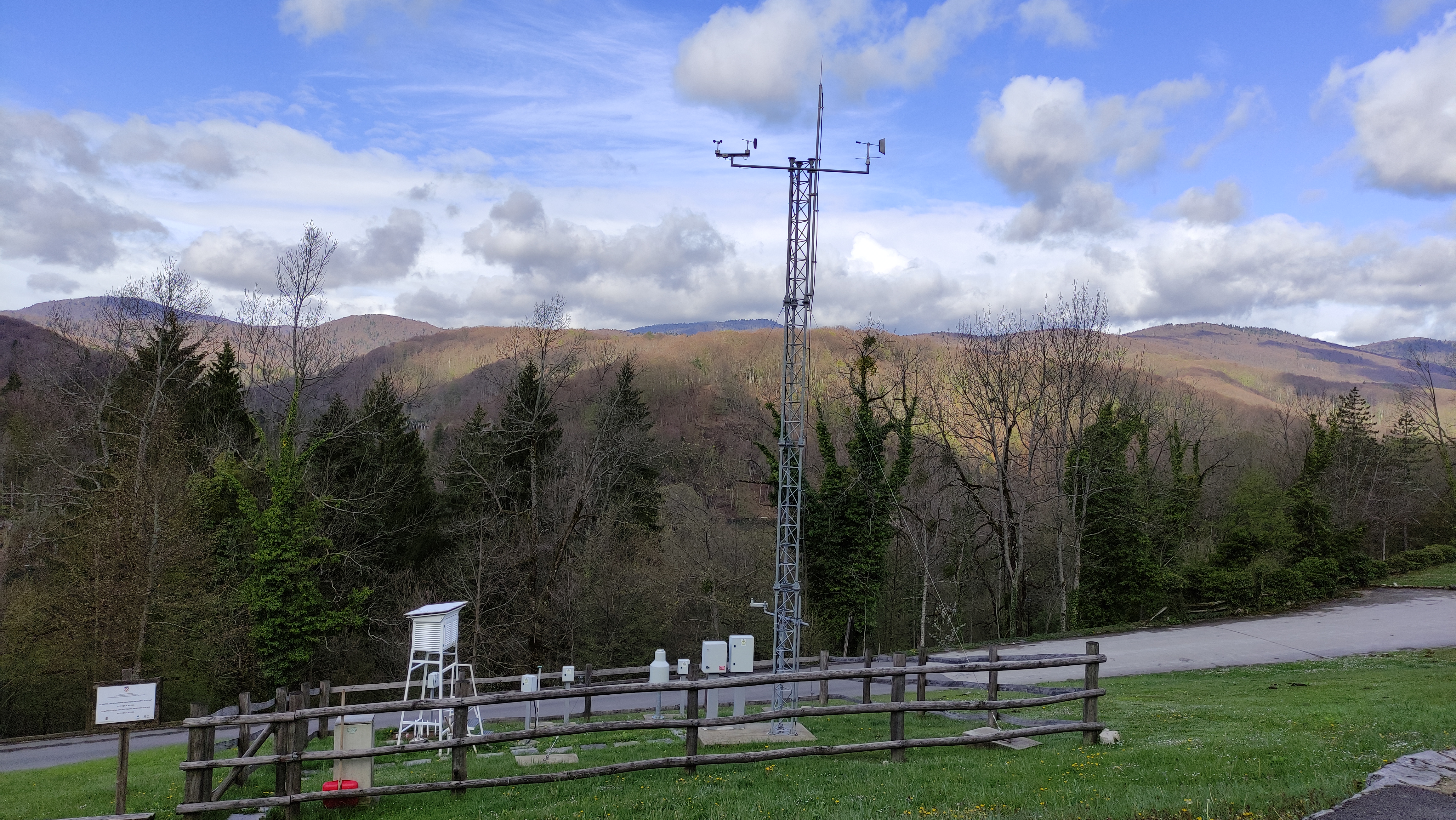
There is an automatic weather station in Plitvice Lakes National Park, which is used for recording data on air temperature, wind direction, amount of precipitation, and ground temperature. This valuable data is sent daily to the Croatian Meteorological and Hydrological Service in Zagreb. It makes sense to mention that this year marks 160 years of measurements for the weather station at Grič in Zagreb.
Our beautiful atmosphere, which has been undergoing changes over millions of years of Earth’s formation and geological history, is split into multiple layers. There is no clear boundary between the atmosphere and outer space; rather, it simply vanishes gradually into outer space. It is the reason why there can be life on Earth in the first place–as it was, and as it is now. It consists of various gases, with greenhouse gases–carbon dioxide, methane, ozone, water vapour, chlorofluorocarbons, and nitrous oxides–being the most important for climate change. These gases can also be called “heat-trapping gases” because they absorb solar heat and hold it in the atmosphere, thereby making our planet “warm” and suited for life. Like a thin blanket keeping you warm in the cold. What happens when there are too many greenhouses gases? When a lot of CO2 is emitted into the atmosphere? Does it disappear into outer space? Unfortunately, no. These greenhouse gases, now present in incredible quantities because of human activity, are accumulating in the atmosphere and increasingly trapping solar heat, with a certain amount of heat still leaving the planet.
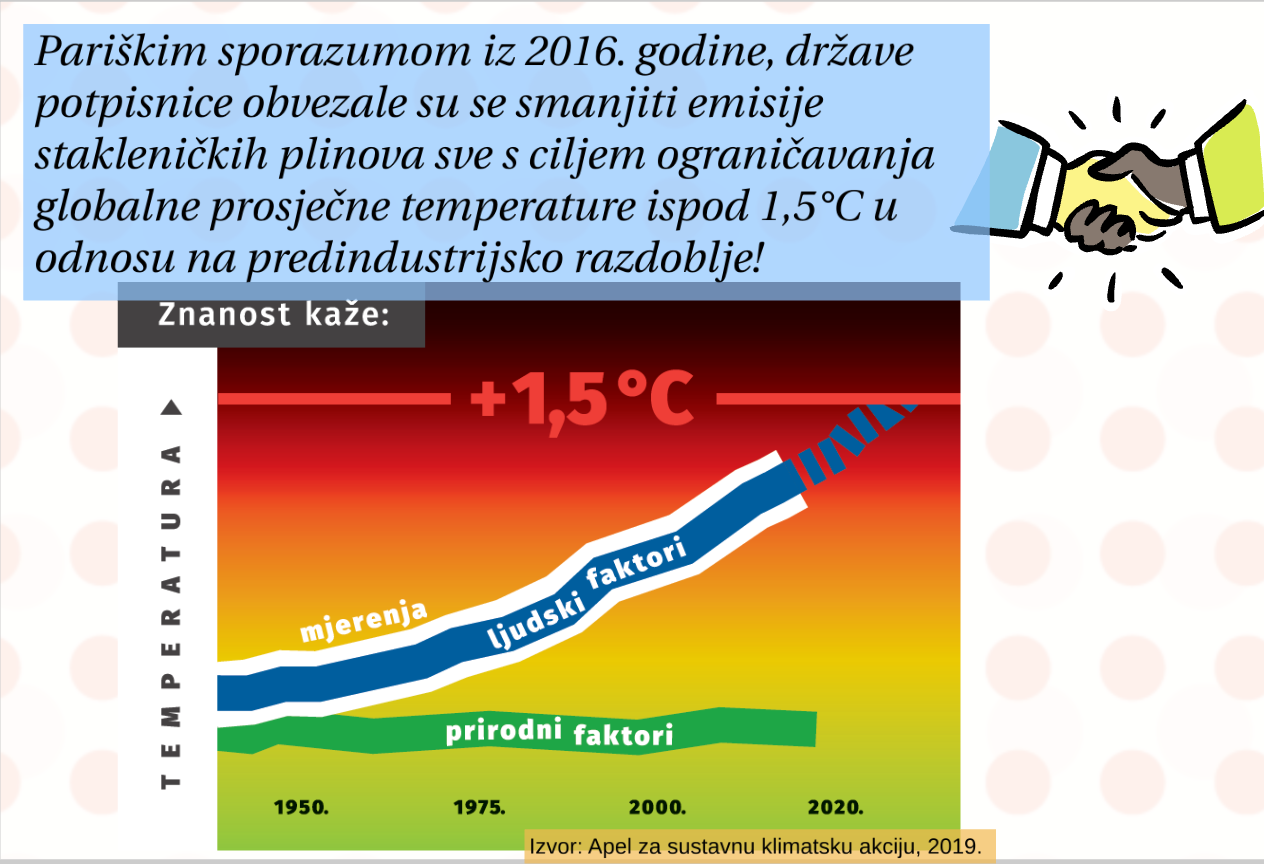
Scientists have established that human activity has caused a temperature increase of around 1°C, i.e. global warming compared to the pre-industrial era, and that temperature will probably increase to 1.5°C between 2030 and 2052 if it continues increasing at the present rate. It is estimated that anthropogenic global warming has lead to temperatures increasing 0.2°C per decade, including all previous and current emissions. Observations by the World Meteorological Organization have shown that methane was 260% more abundant, and nitrous oxide 123% more abundant in 2019 compared to the pre-industrial era. Rising levels of carbon dioxide in the atmosphere compared to the pre-industrial era, when it stood at around 280 ppm, are very significant, and the latest available data on carbon dioxide concentrations at the Mauna Loa Observatory on Hawaii show a concentration of 417.64 ppm for March 2021! Trapped solar heat leads to drastic changes in conditions on Earth. There is an increase in air temperature and an increase in ocean and sea temperature, melting ice, a gradual rise in sea levels, ocean acidification, severe droughts and incredible amounts of precipitation, i.e. the occurrence of extreme weather conditions is becoming more frequent. These changes are a clear indication that the climate on Earth has changed significantly.
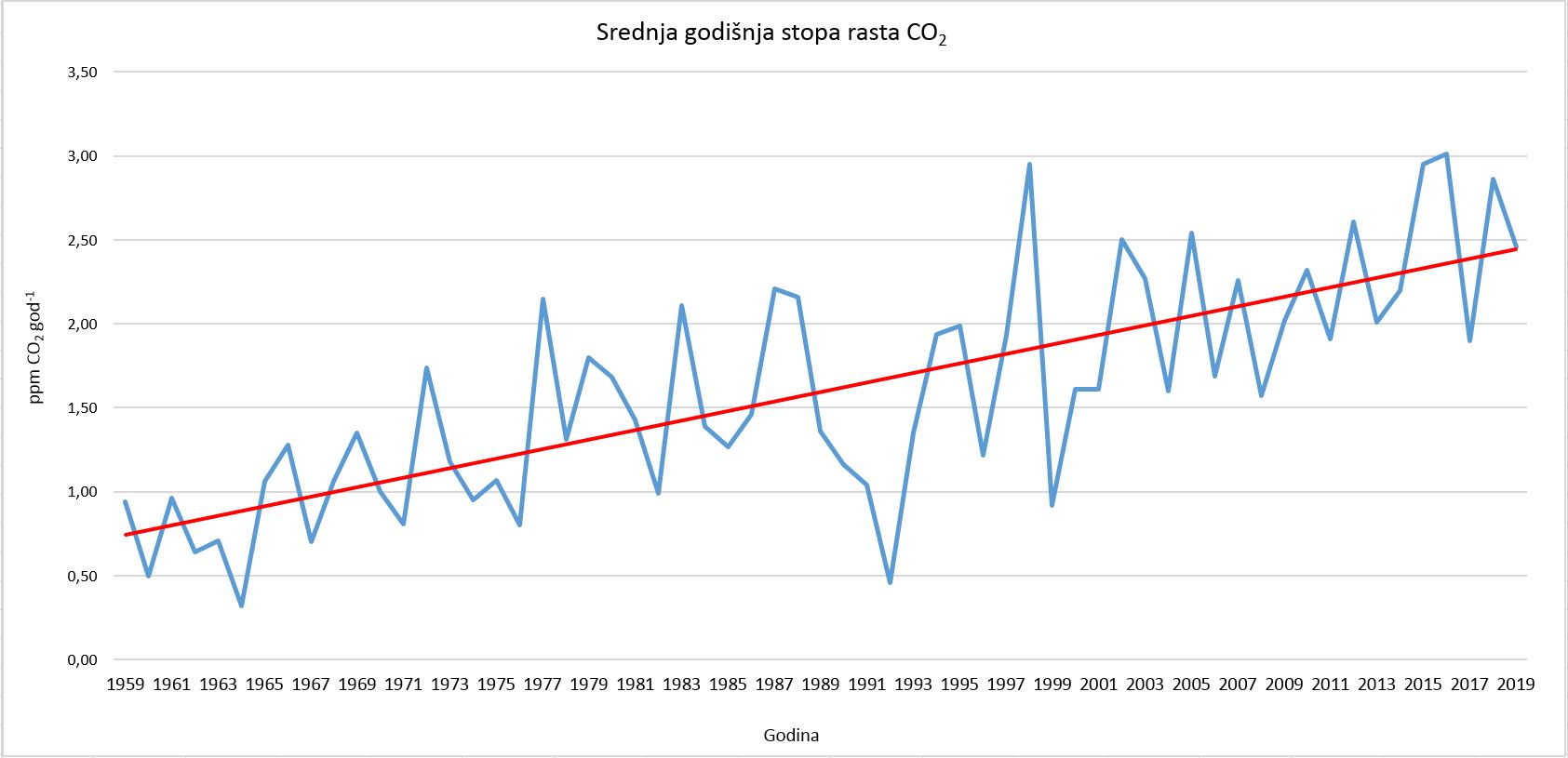
You can see how the average annual growth rate of carbon dioxide concentration has changed since 1959, according to the latest data for the measuring station in Hawaii, in the following graphic. Unfortunately, the trend is positive and likely to continue growing unless something is done urgently.
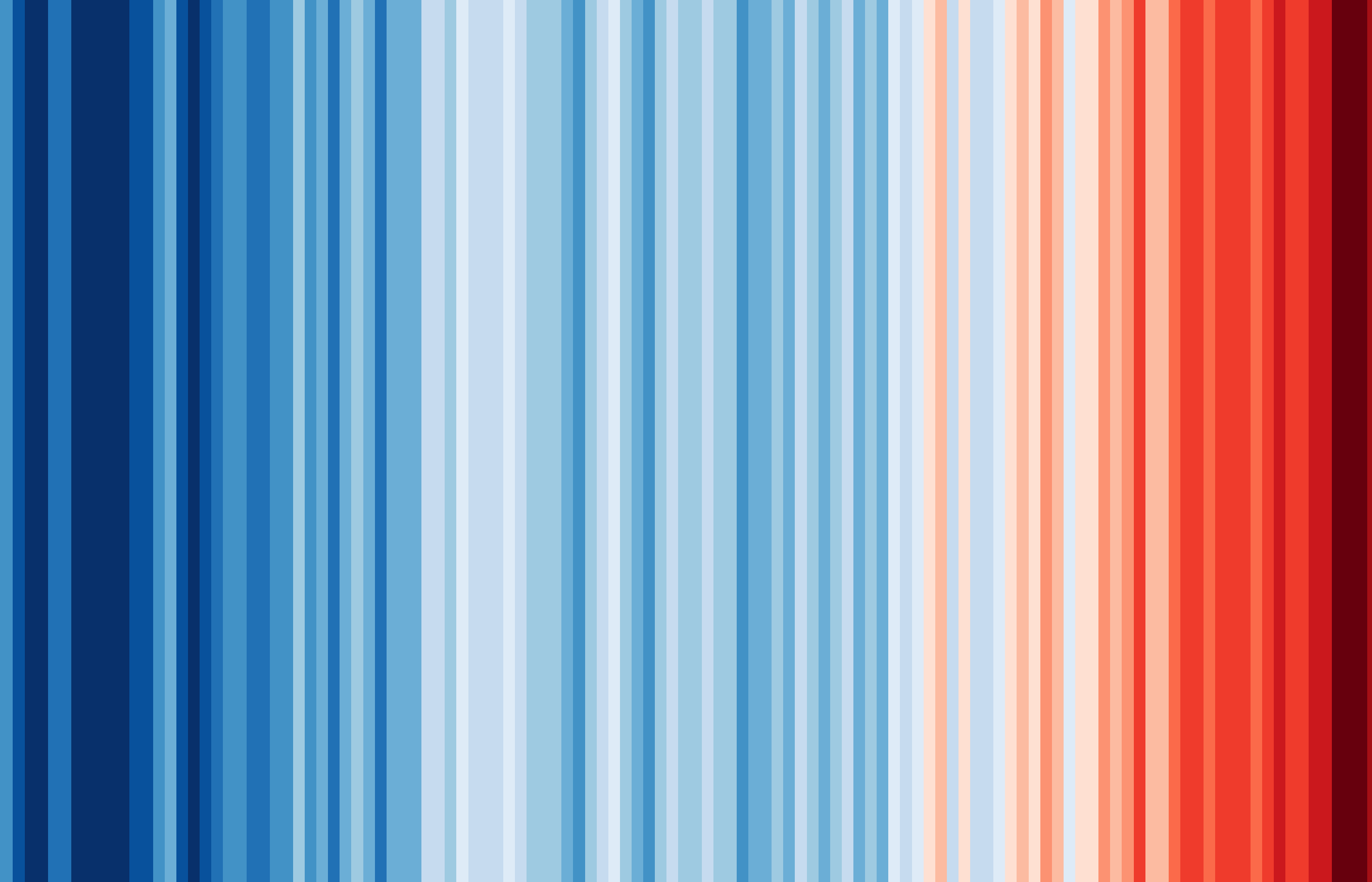
For the Republic of Croatia, significant temperature changes for the period from 1901 to 2020 can be seen very clearly on the website https://showyourstripes.info/, with blue (light blue to dark blue) indicating lower temperature values, while the red color spectrum indicates an increase in air temperature.
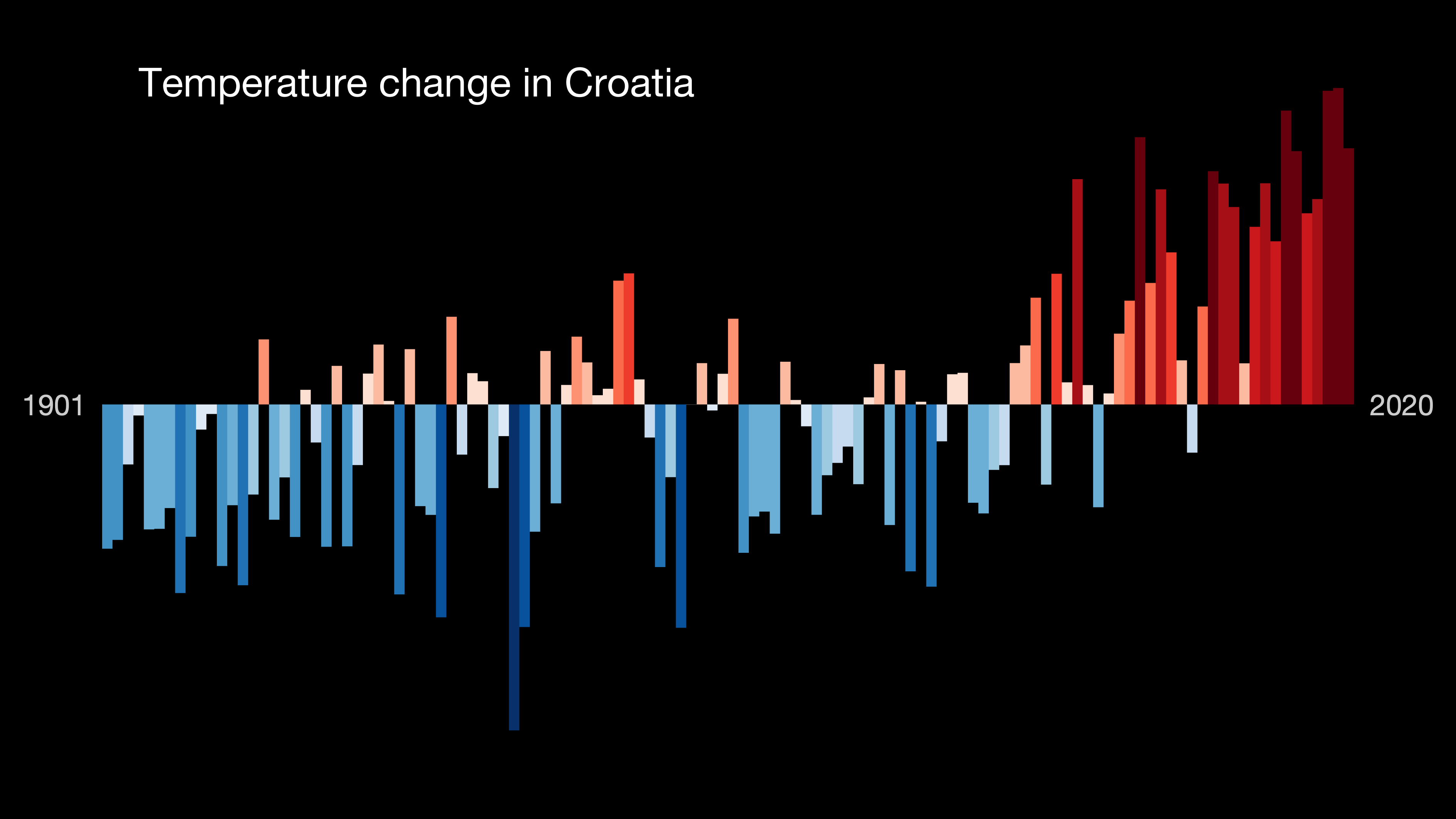
Photo: Changes in temperature values from 1901 to 2020 for Croatia (Source: https://showyourstripes.info/)
And what to do? There are many possibilities and humanity is moving slowly in the right direction, although it is negligible how much faster they should actually react. Various agreements are signed, many conferences are held, climate strikes are held, the awareness of energy production and consumption is changing in order to make it more sustainable and significantly carbon-free. Special attention was paid to the Paris Agreement, to which the Republic of Croatia is a signatory. According to the Energy Development Strategy of the Republic of Croatia, a 32.8% reduction in greenhouse gas emissions is expected by 2030, and an increase in the share of renewable energy sources (RES) in electricity production to 60% compared to the initial state of the current 45%.
Implementing educational activities to raise awareness of the topic of climate change among all ages and generations is extremely important and lays the foundation for responsible behavior, especially towards future generations. Through educational activities, we certainly learn something more or lay the foundation for growth and development in order to change our lives for the better or so that by our example we can perhaps change the world we live in, which is endangered. Many schools around the world are already implementing curricula on climate change, and Croatia is gradually updating this issue in schools by teaching about sustainable development, and the intention is to bring this important issue of climate change into classrooms in order to make students aware of what is happening to the Earth and become ambassadors of a better future. A positive step has already been taken towards creating an interesting educational game “Climate Fresk“, designed by the Frenchman Cèdric Ringenbach, which aims to explain in a fun way what climate is and what the causes and consequences of climate change are.
Plitvice Lakes National Park has certainly raised awareness of the importance of the issue of climate change impacts, and through educational workshops we will try to bring this topic closer to children and young people. Check out what it was like at one of these educational workshops here. Join us in further monitoring activities and information about climate change!