


The soil map of Plitvice Lakes National Park was produced in cooperation with the Faculty of Forestry and Wood Technology of the University of Zagreb between 2021 and 2024. The research was coordinated by Professor Nikola Pernar, PhD.
Systematic surveys of the genetic, physiographic and geographical characteristics of soils throughout the Park were conducted for the purpose of producing the soil map (Fig. 1). The final output is a soil map with an accompanying explanatory study describing the genetic, physiographic and geographical characteristics of the soils. The surveys covered the Park’s entire land area, including marshland, as well as areas along its outer boundary, and included extensive fieldwork, laboratory soil analyses, data processing, a literature review, and preparation of the final soil map and accompanying explanatory study.
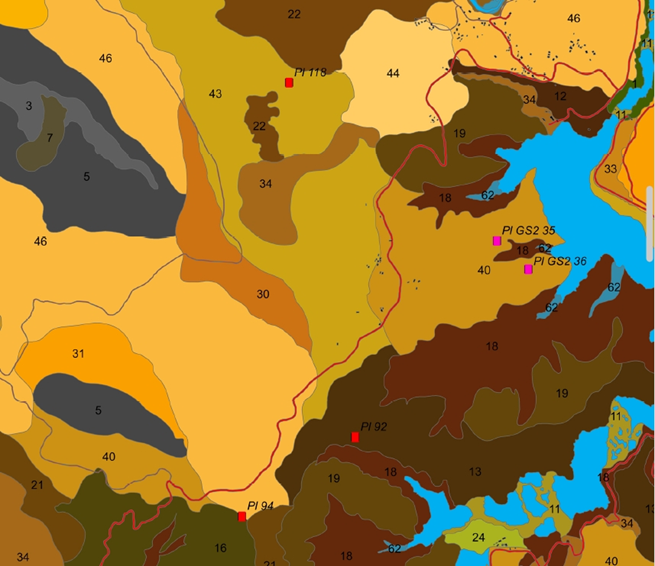
Detail of the soil map for the central part of the Park
Combining grid-based soil mapping with boundary-line mapping, and taking into account the distribution of existing soil-profile data from earlier surveys, data were collected at approximately 1,400 points, of which 1,390 relate to the three-year survey described above (Fig. 2). At 141 points, soil samples were collected from soil pits and boreholes for laboratory analysis. In total, including evaluated soil data from earlier surveys, the key pedogenetic, ectomorphological and physiographic data on soils in Plitvice Lakes National Park are now available for 193 points.
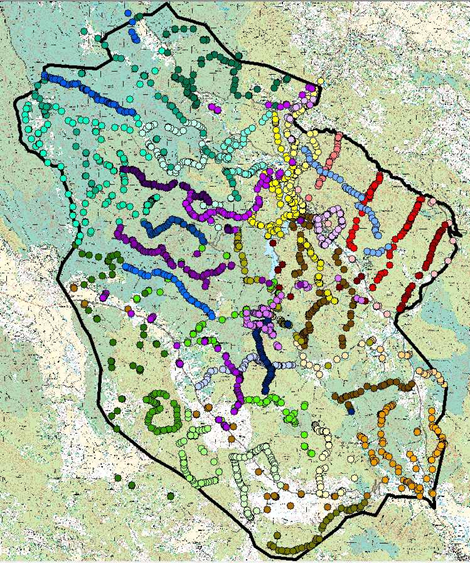
Distribution of the 1,390 field soil survey points
The soil map is available for use in ArcGIS and has been printed at a scale of 1:25,000. The map legend lists 64 mapping units, numbered from 1 to 64. The names of the soil units follow the nomenclature of the Croatian soil classification system and the international World Reference Base for Soil Resources (WRB). Overall, 16 soil types are represented in the Park, comprising 30 subtypes and more than 40 varieties.
The map provides an overview of the spatial relationships between soils at the level of soil mapping units. The most widespread soil type in Plitvice Lakes National Park is calcocambisol (brown soil) on limestone and dolomite, accounting for 52.13% of the Park’s pedosphere (Fig. 3), followed by rendzina (22.95%), lessivated soil (12.72%) and black soil on limestone and dolomite (9.89%). All other soil types together account for only 2.32% of the Park’s pedosphere. The study concludes with an assessment and recommendations for soil monitoring in Plitvice Lakes National Park.
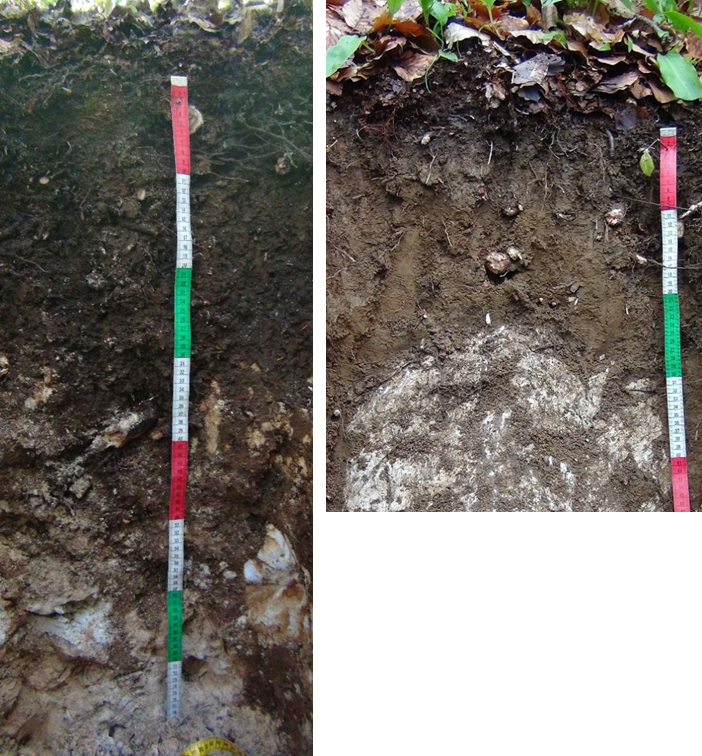
Calcocambisol on dolomite – 1,000 m SW of Crni Vrh and NW of Vukmirovići, field survey point 129 (left);
calcocambisol on limestone – above Zaklopača (NE of Oštri Medveđak), field survey point 7 (right)